
Working With AI – What five assistants have taught us at AIWS Lumina Lab
August 9, 2026




Reimagining storytelling as a force for trust, human connection, and the elevation of civilization in the Age of Artificial Intelligence.
———-
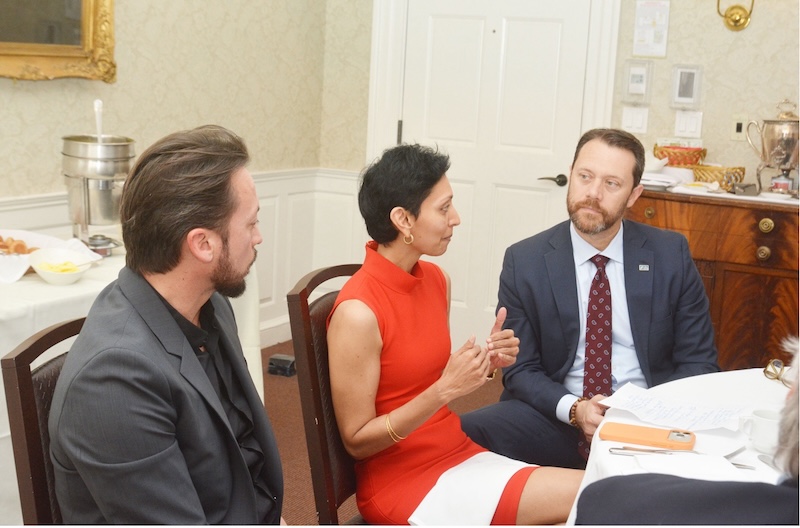
At a pivotal moment in history — when artificial intelligence is rapidly transforming how stories are created, distributed, and experienced — the question is no longer only how technology will shape film, but how film will shape humanity. On May 1, 2026, at the Harvard Faculty Club, the Boston Global Forum convened a distinguished dialogue with Hollywood leaders to explore a defining challenge of our time: how to ensure that storytelling in the AI Age remains deeply human, trustworthy, and capable of elevating civilization.
The luncheon dialogue was part of the conference America at 250: A Beacon for the AI Age and featured filmmaker Gita Pullapilly, actor and producer Don Lee, and Jason Carter, Chair of The Carter Center Board of Trustees.
The discussion centered on a fundamental question: in the AI Age — when technology can generate images, edit films, write scripts, and transform production — how can humanity ensure that human beings remain at the center of storytelling, preserving emotion, trust, identity, and human dignity?
Gita Pullapilly emphasized the irreplaceable role of emotional storytelling. She argued that storytelling creates human connection, breaks barriers, and builds trust through emotional safety. She warned that if younger generations outsource their storytelling to AI, society risks losing the ability for reflection, self-understanding, and authentic human connection.
She also highlighted a structural challenge within today’s media landscape: algorithm-driven platforms often prioritize engagement over meaning, making it difficult to produce films that create deep human impact. In this context, she pointed to the importance of new models of filmmaking aligned with human values.
AIWS Film Park emerged as a key idea in this direction. Gita Pullapilly connected her perspective to Nguyen Anh Tuan’s vision of an AIWS Film Park in Vietnam — a creative space where AI is used not to replace human storytellers, but to support them in producing films for the good of humanity, with global reach and purpose.
This vision opens the possibility of a new creative paradigm: Hollywood, Boston, Vietnam, and global partners working together to build films that do more than entertain — films that inspire, heal, connect, and elevate humanity.
Don Lee shared insights from Hollywood and the action and stunt world. AI is transforming production — enhancing safety, optimizing workflows, and assisting in editing and shot design. However, it also risks diminishing human skills and reducing the number of creative professionals. He stressed the importance of safeguards to ensure that AI does not override human judgment or logic.
Jason Carter reflected on generational change and identity. Younger generations still tell stories — but differently. The key challenge is ensuring that they remain at the center of their own narratives. If storytelling and reflection are outsourced to AI, a fundamental question arises: who are we?
The luncheon dialogue was lively, dynamic, and intellectually rich, with insightful contributions from scholars and participants from MIT, Harvard, and the broader Boston intellectual community. Their perspectives extended the conversation beyond Hollywood, linking film and storytelling to education, journalism, intellectual property, democracy, human identity, and the future of human creativity in the AI Age.
The dialogue also addressed broader systemic challenges: the rise of algorithm-driven content that can numb audiences; the potential contraction of the creative workforce; the erosion of traditional copyright frameworks; and the need for trusted filters to distinguish meaningful storytelling from overwhelming AI-generated content.
A key insight was that the most meaningful stories are often untold stories — stories that cannot be predicted or generated by algorithms, but must be discovered and created through human experience, creativity, courage, and moral imagination.
In his concluding remarks, Nguyen Anh Tuan, Co-Founder, Co-Chair and CEO of the Boston Global Forum, expressed deep appreciation to Gita Pullapilly, Don Lee, Jason Carter, and all participants.
He emphasized that the discussion marks the beginning of a new direction: developing standards for “Film for Humanity in the AI Age.” While the speakers highlighted challenges and risks, Nguyen Anh Tuan stressed that the mission of the Boston Global Forum is not to focus on challenges alone, but to advance solutions through collaboration.
“Boston Global Forum does not focus only on challenges. We focus on solutions. We will collaborate to find solutions.”
He affirmed that BGF will work with artists, educators, technologists, Harvard, MIT, the Boston intellectual community, and Hollywood to address the impact of AI on culture, film, and music.
Nguyen Anh Tuan further highlighted that film is a central pillar within AIWS, with the power to elevate humanity, inspire reflection, and create meaningful change. He connected this vision to the development of AIWS Film Park and upcoming initiatives on Film for Humanity in the AI Age, where AI will serve as an assistant and agent — supporting human creativity rather than replacing it.
He emphasized that Boston, as a global intellectual capital, together with Hollywood and international partners, can lead this transformation. Through collaboration, he expressed confidence that this effort can achieve a historic breakthrough for film in the AI Age.
What emerged from this dialogue is not only a reflection on Hollywood in the AI Age, but the beginning of a new standard: Trust in Film.
In an era overwhelmed by synthetic content, algorithmic amplification, and AI-generated noise, the future of storytelling will not be defined by volume — but by trustworthiness. Film must become a trusted medium again: trusted in its origin, its intention, its emotional truth, and its impact on society.
This is the foundation of Film for Humanity in the AI Age — where storytelling is guided not only by creativity, but by responsibility, authenticity, and human dignity.
At the same time, this vision calls for something deeper. It calls for AIWS Lumina — a Global Cultural Architecture for the AI Age — to restore meaning, connection, and the human spirit within storytelling. If Trust Infrastructure defines what we can rely on, Lumina defines what we can believe in.
Together, they establish a new paradigm: not only films that are intelligent, but films that are trusted, meaningful, and elevating.
This is not just the future of film. It is the future of civilization in the AI Age.
Working With AI – What five assistants have taught us at AIWS Lumina Lab
August 9, 2026

From Alphago To The Humanoid Robot
August 2, 2026
July 26, 2026
The Boston Commitment: A Historic Call at a Defining Moment for Humanity
July 20, 2026

AI World Society - Powered by BGF