Beacon Papers No. 14: From a Method to a Civilization
October 5, 2026




At the G20 Innovation Ministerial in North Carolina on September 2, U.S. Secretary of Commerce Howard Lutnick urged governments to allow AI companies to train on copyrighted works under fair use, while finding ways to protect artists and creators. NVIDIA CEO Jensen Huang, OpenAI CEO Sam Altman, Anthropic co-founder Tom Brown, and Palantir CEO Alex Karp were among the technology leaders taking part.
The intervention raised a cultural question to the level of global economic policy. Frontier AI now depends on an inheritance created across generations — literature and journalism, music and recorded performance, painting and photography, film, scholarship, and the accumulated languages and traditions of humanity. The G20 did not settle the question of how that inheritance may be used. It placed it unmistakably on the global agenda.
On August 31, musicians Jason Isbell, David Lowery, Guy Forsyth, and Eduardo Calle filed a proposed class action against AI music company Suno in federal court in Massachusetts.
The case is notable for what it does not claim. It does not rest on copyright at all. Its seventeen counts arise under state right-of-publicity and personal-identity laws, proceeding on identity and biometric privacy rather than ownership of recordings or compositions — while Suno separately faces copyright actions from Universal Music Group, Sony Music Group, and Round Hill Music.
The complaint’s central contention is that the platform indexes musicians by name: that the system treats an artist’s name not as a string of text but as a retrieval key to performer-specific representations encoded within the model, so that a name alone produces a song, a description, and an image evoking that musician. Suno says the claims are without merit, that it blocks prompts for specific artists’ names and copyrighted songs, and that it screens uploaded audio and lyrics through third-party providers.
Whatever the outcome, the case exposes a boundary copyright does not reach. A person’s creative identity is more than a collection of protected works. It includes voice, style, reputation, and the relationship built with an audience over a lifetime. A system may avoid reproducing any particular song while deriving commercial value from sounding recognizably like the human being who made it.
The third development is happening not in a courtroom but in Venice. At the 83rd Venice International Film Festival, September 2–12, works created with generative AI may be submitted — but it is mandatory to declare how and at which stages of production AI was used.
That requirement is small in wording and large in principle. One of the world’s oldest film institutions has decided that AI-assisted work belongs in its halls, and that the audience is entitled to know where the machine took part. Disclosure, not prohibition. It is the same instinct that AIWS has built into the Co-Creation Note.
The debate is organized around three questions: who may use the data, who should be paid, and whether AI can be an author. Each is necessary. None amounts to a philosophy of culture.
Fair use may protect socially valuable learning, but it does not guarantee recognition or shared prosperity. Licensing may provide payment, but a purely transactional system can concentrate power in platforms and intermediaries while leaving individual creators unseen.
Both frameworks share an assumption worth examining: that the relationship between human creativity and machine capability is a question of ownership. Ownership asks who holds title to a work. It does not ask what a work meant to the person who made it, what it will mean to the person who receives it, or what should be made next.
This is where AIWS Lumina enters, and why it is not an ornament to the legal debate but the part that determines its purpose.
The courts ask whether rights were violated. The G20 asks how companies may lawfully learn. Festivals ask what may be shown. AIWS Lumina asks the question that gives the others their point:
What should humanity create with AI — and how can that creation make human life more beautiful, noble, and wise?
Culture cannot be governed as training data alone. A novel is not a sequence of tokens, a song is not a pattern of sound, a painting is not a visual input. Each carries experience, memory, identity, and meaning. AI may learn from humanity’s inheritance, but it must not erase the dignity, authorship, or livelihood of those who created it.
AIWS Lumina holds that the measure of a creative work in the AI Age is not only who owns it, but whether it was made with Love, Creativity, Nobility, and Wisdom — and whether it leaves the world with something worth inheriting. In Lumina’s terms, what a person contributes is a Hạt Sáng, a seed of light: something new, beautiful, and noble, given to the life of others. That is a standard no licensing regime can supply and no court can award.
From that standard follows a structure: recognition, attribution, contribution, and shared benefit.
Recognition acknowledges the people and communities whose creativity made new capability possible. Attribution preserves the traceable relationship between source, authorship, and new work. Contribution recognizes that value arises from many forms of creative participation, not only from holding a copyright. Shared benefit ensures that gains produced from a collective inheritance do not accrue only to those operating the largest models.
This does not require every output to carry an impossible list of sources. It requires systems that preserve provenance, measure meaningful contribution, distinguish inspiration from imitation, and let creators share in the value drawn from their work. The Creative Capital, Knowledge Capital, Trust Capital, and Contribution Capital of AIWS Civilization provide the foundations for such an economy, extending the measurement of value beyond attention, ownership, and market power.
So the question in the title is the wrong frame, and the week’s events show why. No one owns human creativity as such, though creators hold legitimate rights in their works, identities, and contributions. Creativity is received from a human inheritance, transformed by each generation, and given forward again. What must now be decided is whether those who carry it forward are recognized — and whether what humanity creates with AI is worthy of becoming part of that inheritance.
The future of culture is not a contest between human creators and artificial intelligence. It is a new age of Human–AI Co-Creation in which technology enlarges creativity, honors human authorship, and turns the inheritance of the past into new works of beauty, nobility, and wisdom.
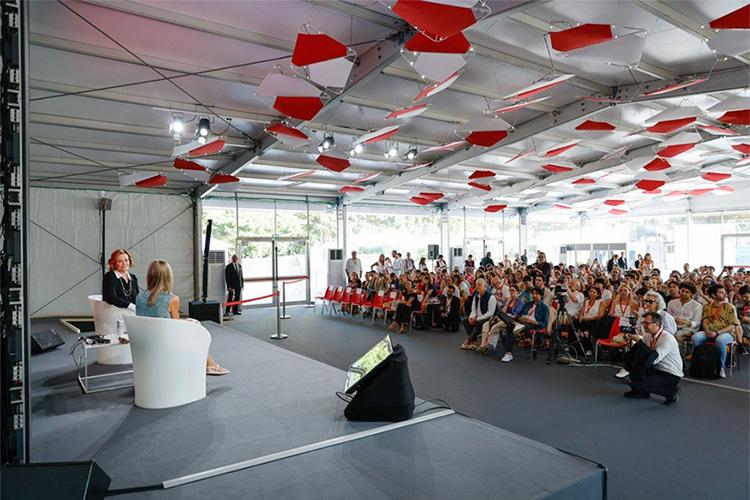
At the Venice International Film Festival, AI-assisted cinema is entering established cultural institutions—bringing new questions of disclosure, authorship, and Human–AI Co-Creation. Photo: La Biennale di Venezia
Beacon Papers No. 14: From a Method to a Civilization
October 5, 2026
From Alphago To The Humanoid Robot
August 2, 2026
July 26, 2026

Lumina: A Noble AI Companion for Every Person in the Age of AI
May 31, 2026

AI World Society - Powered by BGF